
In conversation with Joanna Holland
by Zoe Gouli
Earlier this year originalprojects; Marketing Assistant Zoe Gouli talked with artist Joanna Holland about her exhibition Out of the Blue, as well as her collaborative process, creating around chronic illness, loss of biodiversity and her influences from the horror genre.
May 2023
Zoe Gouli (ZG): Out of the Blue is your first solo exhibition; how do you feel it has gone? What are your thoughts on your first solo exhibition being one that travels between multiple venues, having shown this work at originalprojects, Attenborough Arts Centre and other venues?
Joanna Holland (JH): It has been an amazing experience for me for all sorts of reasons. Mainly, I’ve been positively overwhelmed by the responses that I've had to my work. In both galleries there was an opportunity for people to leave responses to the exhibition and to share their own experiences of chronic illness. We received over 280 responses, which feels extraordinary. A big reason for doing this exhibition was to try and carve out a space for people to talk about invisible disability and chronic illness, and I really feel that that was achieved, so that fills me with a lot of joy. As does working with a whole heap of wonderful people at each venue and my collaboration with artists and others. The whole experience has been brilliant.
ZG: What has been the reception of your work in the cultural and social landscape of Great Yarmouth? Did you feel it impacted people in a different way there compared to other places?
JH: There's a physicality that's really different about the spaces I’ve shown this work in. I was delighted to be working in the physical space of Great Yarmouth; I feel very connected to Yarmouth & to the sea. I went to university in Norwich, and we always used to escape to Yarmouth and the seaside, which was wonderful to return to again.
All of this work originated from a conversation with Rachel Graves, the Visual Arts Officer at Attenborough Arts Centre, about the two photographs of my privacy curtains in my hospital ward, which I had flipped around to look like seascapes. So I was really happy to have that connection to Yarmouth – as of course Leicestershire is completely different geographically. They're also entirely different venues with completely different kinds of audiences. Attenborough Arts Centre in Leicester is part of the University and it has a big focus on inclusivity and accessibility. 20 - 25 % of their visitors identify as disabled, which for a gallery is really unusual, though of course it shouldn't be, given that that exactly mimics the percentage of disabled people in the UK’s population. I want my work to be accessible to everybody. PrimeYarc being inside a shopping centre was a completely different context. Accessibility is explored in such a unique way there. That led to the conversations I had to be fairly informal, both with fellow artists and members of the public, that often centred around their own lived experiences of chronic health. I left Yarmouth with all those conversations in mind. PrimeYarc was a joy for that reason; it’s so accessible, both physically and in its essence as an unpretentious cultural hub. In my mind, that’s absolutely where art should be.
ZG: The way this exhibition worked in the physical space of PrimeYarc is really interesting; there is a sense of structure and organisation with different sections achieving different things, and an underlying narrative and stream of consciousness that connects them. How did you approach structuring your work in the space? Did you have an idea going into the installation or did the image emerge with time?
JH: When I first visited in the early stages of putting together the show to discuss it with Jules and Kaavous, I was honestly quite intimidated by the space of PrimeYarc as it’s so vast. Kaavous suggested the idea of using hospital ward privacy curtains as a way to structure how people engage with the exhibition. It made perfect sense; those curtains feature in my work in various ways, and once we installed them it all fell into place. The whiteness of the space, the ceiling and floor tiles are similar, if not identical, to that of most hospital wards. We installed the curtains to mimic that three-by-two metre space around your bed – which you’re given in a hospital ward, which is limiting and very isolating. In Leicester, the works were set up differently - it was more of a group viewing experience, but in PrimeYarc, visitors sat on their own to engage with the works with headphones which meant a more intimate, but also isolating experience. Offering this isolating experience to audiences felt important, in the context of the work and narratives around lived experiences of chronic illness. I was shocked by how different the same body of work can look in different contexts. I think the set-up we created in PrimeYarc amplified the medical-based works in particular.
One area of the exhibition was dedicated to the work of artists I collaborated with; I invited artists with a connection to Great Yarmouth to respond to the artworks in Out of the Blue. Following on from my medical-based artworks were works by Dolly Sen and Caroline Cardis who created pieces which explored medications and their side effects. Then, Genevieve Rud’s work was placed nearby; her perspective came from a focus on the natural world and lunar cycles. The narrative connects in to themes of natural solace and a longing for the natural world, which are present in my next series of works. I didn’t give any direction to the invited artists, but their responses were wonderful and tied everything together so naturally.
ZG: Out of the Blue makes a connection between physical illness and loss of biodiversity. How did you come to this connection? Can you expand on it?
JH: I feel like that connection came from everywhere. My whole life I’ve loved nature; I have distinct memories of trying to spend as much time as possible outside when I was a child. That sense of immersion plays a role in it too. I’ve chosen to work in nature where I can and have previously worked with the Cambridge Conservation Initiative, which is a global project that focuses on preserving biodiversity, and with Cambridge Curiosity and Imagination, a charity which co-creates with artists & communities in wild & civic spaces. The work of both of these organisations informs my current practice but I’ve always wanted to be a part of this conversation. I’m constantly aware of what’s happening to our world, our collective lack of care for our planet and our biodiversity, and of course the climate crisis.
Extremely poor health and several hospitalisations meant that I had to reassess how I work during the pandemic. I've always had a participatory practice, and a socially engaged practice but catching Covid 19, combined with my pre-existing conditions, made my participatory practice impossible. I had to completely change how I worked and this was really quite difficult. As a result I moved towards a sort of ‘remote practice’ – using media where I didn’t always need to be physically present, such as sound, photography & artist video. The product of that was the ‘not-so-present’, film and soundscapes that audiences experienced in Out of the Blue. During this period of change, the concept of precarity stuck with me; the narratives of care, and the marginalisation of Disabled people, and how this echoes the way we treat our biodiversity – especially endangered species in the wild. I couldn't help drawing parallels between those kinds of existences. I also wanted to draw out this idea of the marginalised and the invisible; Disabled people and those living with chronic illness are everywhere, we’re a huge part of the population, and yet we remain invisible.
On the other hand there’s a solid, practical link between these themes. I crave natural environments when I’m ill, which I physically can’t reach. Then once I’m better I can be in nature again, and I’m struck by how lucky I am to be well enough to access it. I think we should all be viewing the natural world in that way, regarding it as precious.
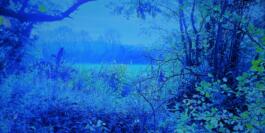
The triptych first walks shows three different square images of the natural world and explores exactly that feeling of re-emerging into nature. The photographs were printed onto brushed aluminium - a rough surface, so when you move around them they sparkle a little. As does their sister work rapture – an iridescent blue forest. And that is how I view those special moments of connection with nature; they shimmer in my mind. I’m keen to keep exploring the duality of joyful reunion with the natural world and longing for its solace and comfort when surrounded by the synthetic.
ZG: You seem to create in stark contrasts; internal and external; the entrapment of droning mechanical sounds in a hospital and the freedom of birdsong; bright neon and dimness; motion and stillness. It could be read as a mirroring of the contrast between the “action” of medical procedures and the “inaction” of recovery. Why do you think contrast is a recurring theme in Out of the Blue ?
JH: Great observation. It’s done deliberately but it’s also the nature of how I work. They are definitely contrasts like you said, but in my head I think of them as disruptions or interruptions. It appears more in the videos; I’d say it grows out of different things. Life with chronic illness is a life disrupted. There’s a sort of constant disconnect - when you want to do something but your body has other ideas. The video work school run is very much about just trying to have some sort of a normal ordinary life, where I’m walking my daughter to school, which is then disrupted by the loud hum of the medical scan. It’s an honest exploration of how those of us with chronic illness exist but also our family life; punctuated by flares and remissions.
Some of the photographic works are about being in hospital. There's a diptych called ascent/good day and another called descent/bad day. I wanted to highlight the unsteadiness of having chronic illness, where you can have a run of a good few days and you get excited, but it doesn't mean that the next day is going to be the same. It’s so unpredictable. It’s all about control, or rather the lack of it.
Out of the Blue shares my lived experience of losing my colour vision. I was walking across a bridge in and all of a sudden everything went grey apart from the colour blue, which was so vivid it was hard to look at. The medics best guess was that it was a really rare side effect of some new immunosuppressant medication I’d just started. What I was experiencing at the time was something called cyanopsia and photophobia. Whilst this was not a permanent change, the weeks it lasted for were pretty terrifying and I’ve used this experience of a ‘blue world’ as a device from which to share lived experience of chronic illness. This also led to me wanting to explore the contrast between darkness and brightness, which parallel my constant flare-ups and periods of remission.
ZG: Collaboration seems to be something you have done throughout your career; most recently with Dolly Sen with her performance and Chloe Page with creative captioning. How do you think the introduction of other viewpoints into your “world” has created changes there, if at all?
JH: I really loved having all the input from all of the artists I collaborated with. Chloe has this amazing talent for writing creative captions. Caroline actually had two different roles in the project. She was invited as an artist to respond to the work, like Genevieve and Dolly, but she also worked as a creative producer on the project.
I always work collaboratively in some way. Out of the Blue is actually probably one of the least collaborative of my projects. I think that everybody brought something extraordinary to the table. It's fascinating to me that a person will look at the same body of work and bring such a different response to it. With Chloe’s work, for example, I could never have written the creative captions that she did. There was plenty of dialogue between us but she brought her unique perspective to the creative process, bringing a whole new way to read the work. And I'm really pleased that it’s something that's completely embodied in the work. It's not an add-on; it was a part of the creation of the work. Of course, initially those captions were created for d/Deaf people, but I also think they act as an artwork in their own right. The captions were heavily commented on by visitors; it’s really helped all sorts of people to engage with the soundscapes. So that's been brilliant.
Dolly’s performance was fantastic. It was quite remarkable in how different it was to everything else that was going on in the space. It was wonderful for many reasons, but I loved it all the more for how different it is to how I work. Although our practices definitely speak to each other. Dolly’s sense of humour is essential for us all; in the way that it rips through the inherent heaviness that comes with talking about chronic health and reminds us that, actually, we are still all human. It’s very powerful.
I really loved the fact that every artist has such a different response to my work. They each responded to and brought out such contrasting aspects of my work and highlighted these, along with their own lived experience. This varied from Caroline and Dolly’s exploration of side effects and even lived experience of contraindicated medication, through to Genevieve’s amazing relationship with the natural world. Genevieve is so in tune with the natural world, and it felt special to have the conversations we did which acknowledged our shared thinking about care and the intrinsic restorative powers of nature. So it was really wonderful to have all these artists. I can't really imagine working non-collaboratively.
ZG: I found that elements present in your short films are emblematic of the horror genre, with loudness then silence, motion then stillness, and the intentionality of letting discomfort sit with the viewer. Did you draw inspiration from anywhere in particular when creating your films?
JH: I’m really pleased that you picked up on this, because horror is something that runs through my work. I think horror as a genre lends itself to exploring and unpicking societal neurosis and ‘othering’. I particularly enjoy folk horror, like ‘Wicker Man’ and Ari Aster’s work such as ‘Midsommer’. Also, the recent trend for horror which explores our relationship with nature - like Ben Wheatley’s ‘In the Earth’ and Jaco Bouwer’s ‘Gaia’. Horror is a flexible space where you can really play with reality, imagination, memory, and dreams. And this is such a massive part of my practice. I did a course a little while ago in experimental film and I learned the power of letting discomfort simmer (thanks to James Rollo). Sitting with discomfort feels important in this context, as I’m often sharing experiences which were prolonged for me, so it made sense to extend that into my work. Although I didn't draw on any particular horror devices intentionally, I know that there are references within my work. I watch a lot of horror films, so it's probably embedded in my mind in some ways. During this period of change in my practice, I actually wrote a horror film script - inspired by the frustrations of living with an unpredictable body and chronic illness. Amazingly it was shortlisted by Salon Pictures, which felt pretty special. So if there's anyone out there that would like to fund a horror film about chronic illness please get in touch!!
A phrase that I did use in the interpretation for the Out of the Blue exhibition was; sometimes the beauty is in the shadows and the horror in the everyday. For me that sums up living with an unpredicted body. Feeling almost haunted by your own body is definitely a part of this recent work. I suppose one of the things I wanted to do was to emulate that feeling of creeping dread – clearly, this is something that’s present in certain types of horror films. Also, there are those films where you just know that you’re in for a jump scare, you just don’t know exactly when it will happen. And that anticipation can be excruciating. In the case of my illness, I feel like I’m often waiting for my symptoms to suddenly flare (sometimes violently via A&E) although also sometimes seemingly ‘out of the blue’. This anticipation of something that is out of your control is also quite excruciating. And this presents a question: how do you run away from the scary thing if that thing is actually you? These concepts are definitely something I want to return to in the future. And, in fact, I have just submitted a funding bid to explore this – for a collaborative project called The Haunted, which explores the liminalities of different sick bodies through dreaming and lived experiences.